|
PRAISE:
"Russo is the acclaimed
author of three previous books on organized crime, including The Outfit: The Role of Chicago's Underworld in the
Shaping of Modern America (2002). This thoroughly researched investigative
report profiles the hidden power brokers behind the mob's dominance of
Chicago and Los Angeles throughout the second half of the twentieth
century. Most notable is Sidney Korshak, known as "The Fixer,"
who was called the most powerful lawyer in the world by the FBI. A force
behind the careers of numerous celebrities, and with connections to
politicians from Henry Kissinger to Ronald Reagan, Korshak brokered some
of the largest and shadiest deals in Hollywood from his private table at
the Bistro restaurant in Beverly Hills. As point man for the mob he
oversaw a land grabs from interned Japanese Americans during World War
II, helped create the casino monopolies in Las Vegas and facilitated mob
domination of the film and music industries. With a colorful cast of
characters and more clandestine activity than a spy thriller, Russo
delivers some of the juiciest Hollywood details unearthed yet."
--Booklist
“There
are plenty of revelations in this absorbing book.”
--Kirkus
“Veteran investigative author
and organized crime expert Russo's magnum opus is a compelling look at
one of the last century's major power players. Russo's extensive
research is amply evident, and he has made use of recently disclosed
records to paint a fuller picture than predecessors such as Seymour
Hersh and Brian Ross were able to...a worthy addition to the genre.”
--Publisher’s Weekly
"Supermob confirms what we in law enforcement have long known, but were prevented from pursuing: the longstanding relationship between the mob and 'legitimate' politicians and corporate leaders. This is a must-read for the average citizen who wants to know how organized crime has really impacted their lives. Gus Russo has written perhaps the the most long-overdue book on crime in American society. "
- Robert Fuesel, former Special Agent IRS Organized Crime Division, and former Executive Director of the Chicago Crime Commission.
"Long one of our preeminent investigative journalists, Gus Russo here extends his unrivalled research into organized crime into a full-blast biography of Sidney
Korshak, the suave Mob lawyer behind decades of show business and California politics. This fascinating study of the powerhouse second generation of Chicago Russian Jews headed toward Beverly Hills is sociology with sharks teeth in its head, very original and very important."
- Burton Hersh, Fulbright Scholar, and author of The Old Boys, and The Mellon Family
"By exposing America`s Supermob, Gus Russo has done what Congress and the Dept. of Justice should have done more comprehensively years ago. As a former federal investigator, I tip my hat to Russo for this exhaustive and compelling addition to the canon of seminal books on Organized Crime in America. Sidney
Korshak, the ultimate mob lawyer and fixer and some of his ilk are invisible no more."
--Philip Manuel, former Chief Investigator, US Senate, Subcommittee on Investigations and Member of the President`s Commission on Organized Crime
"Gus Russo is America's bravest and most respected investigative author, specializing in the underworld's hidden ties to the
upperworld. Russo's chilling portrait of Supermob lawyer Sidney Korshak is his finest work in a brilliant career."
- Richard J. Whalen, former Senior Editor of the Wall Street Journal and Fortune, author of The Founding Father: The Story of Joseph P. Kennedy.
"With Supermob, veteran muckraker Gus Russo emerges as a primal and primary 21st Century investigative historian of 20th Century corruption.
Tracking the so-called Jewish Mob that evolved out of Chicago's Eastern European immigrant class during and immediately following Prohibition,
Russo's painstaking research and first-rate sleuthing connects the dots all the way to the White House. Anyone who has ever wondered how or why the ship
of state seems to founder so frequently in murky, mobbed-up waters will have their eyes opened wide. Supermob is super, and required reading for any
student of the fine art of influence peddling."
- Dennis McDougal, author of The Last Mogul: Lew Wasserman, MCA, and the Hidden History of Hollywood
"Gus Russo, through some remarkable investigative journalism, has uncovered a dark side American history - especially in California: from the 1940s to the 1980s, an almost untouchable group of exceedingly influential men wielded their enormous business and political power, sometimes criminally, to achieve their ends. The villainy explored in Supermob has always been suggested, but to my knowledge never nailed down and written about in a riveting book. Highly recommended."
- Vincent Bugliosi, former Los Angeles County lead prosecutor, and author of Helter Skelter
"Gus Russo has journeyed to the heart of American darkness and come back with an extraordinary story-how Sidney Korshak and his cohorts manipulated entertainment and politics in the modern era. No political history of our era will be complete without referencing
Supermob."
- Laurence Leamer, author of The Kennedy Men and Fantastic: The Life of Arnold Schwarzenegger
Reviews of
SUPERMOB
There are two kinds of power; the visible and the invisible. Those who wield the latter, writes Russo (Live by the Sword, 1998, etc;), are scarier, more pervasive and harder to bust.
Witness the "supermob," a term coined to describe the "brilliant, amoral" circle of mostly Ashkenazi, mostly poor friends who grew up in Chicago and settled in Beverly Hills. At the Chicago end stood the "Kosher Calcutta," a neighborhood that produced such figures as Paul Muni, Wallace Beery, William S. Paley and Jack Ruby. There Sid Korshak got his start, a young lawyer who allegedly advised Al Capone and helped forge an alliance that wedded big labor to big business to big crime to big pictures. Korshak, by Russo's account, soon had his hand in every criminal enterprise imaginable, and he cut quite a figure as a scene-making, wheeling-and-dealing, attorney who exuded a decided air of danger. Hollywood fell hard for Korshak and the supermob, which used the regular mob to its own ends; MGM head Louis Mayer's best buddy reportedly was gangster Frank Orsatti, while Mafia money reputedly sponsored Marilyn Monroe, Frank Sinatra, even Gary Cooper. When Joe DiMaggio and Sinatra broke into the wrong apartment hoping to find Monroe's in a lesbian act, it was Korshak--"the Fixer"--who got them off the hook. When Jimmy Hoffa came to head the Teamsters Union, he "checked with Sidney on everything he did, and he still got in trouble." Ronald Reagan followed his advice as actor and as a politician, while Richard Nixon benefited handsomely from his friendship with Korshak and his close ties to Teamster--not least for a Beverly Hills lot bought for $35,000, "far below the listed price of $104,250."
It won't surprise any savvy readers to learn that politics, commerce, and crime go hand in hand. Still, there are plenty of revelations in this absorbing, if overlong, book.
--KIRKUS
Veteran investigative author and organized crime expert Russo's magnum opus is a compelling look at one of the last century's major power players: Sidney Korshak, a "sphinxlike operator" who, despite pulling the strings of politics and industry, remained invisible to the general public. With great detail (some of it extraneous), Russo traces the amazing course of Korshak's life -- from his childhood on Chicago's Jewish West Side to his role as a mouthpiece for the Windy City's Mafia leaders and, eventually, as a major league fixer who brokered labor truces and other deals for politicians and Hollywood moguls (Korshak died, aged 87, in 1996). The list of his clients and associates reads like a who's who of the last 50 years, including Ronald Reagan, MCA president Lew Wasserman, hotelier Conrad Hilton and cosmetics king Max Factor. Russo's extensive research is amply evident, and he has made use of recently disclosed records to paint a fuller picture than predecessors such as Seymour Hersh and Brian Ross were able to. His conclusions about Reagan -- such as that he sold out the actor's union -- in particular are likely to create controversy, although similar ones were drawn in Dan Moldea's Dark Victory 20 years ago. This worthy addition to the genre is marred only by some sensational claims concerning Reagan that lack adequate documentation. B&w
photos.(Sept.)
--PUBLISHERS WEEKLY
Los Angeles Times
Book Says Brown Had Ties to `Fixer'
`Supermob' alleges he was linked to attorney Sidney Korshak in the '70s. A campaign aide to the ex-governor denies any such connection.
By Eric Bailey
Times Staff Writer
August 30, 2006
SACRAMENTO — It's been a decade since legendary Hollywood fixer Sidney Korshak was buried following a half-century of rubbing elbows with mobsters, movie executives and politicians.
Now tales of the late lawyer's colorful career — relegated to newspaper archives and dusty FBI documents — could reemerge as political fodder in the contest for California attorney general.
A book scheduled for release next week revives decades-old allegations that Democratic candidate Jerry Brown, during his years as California governor, maintained political links to Korshak and other figures with alleged ties to organized crime.
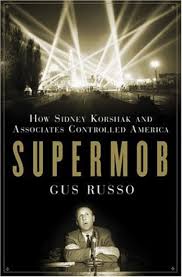
Brown's opponent in the attorney general's race, Republican state Sen. Chuck Poochigian of Fresno, intends to shine a spotlight on the book, "Supermob: How Sidney Korshak and His Criminal Associates Became America's Hidden Power Brokers."
Published by Bloomsbury USA and set to hit sales racks next month, the book by investigative journalist Gus Russo charges that Brown took campaign contributions from Korshak and unions with suspected mob ties during the 1970s, and then granted them political favors.
Brown's campaign strategist, Ace Smith, flatly rejected the book's allegations, calling them moldering nonsense that should be left entombed.
"It's laughable and idiotic," Smith said. "It's in the same category as Bigfoot and the Loch Ness monster. If you're looking for information like that, you should check out Al Capone's vault."
A spokesman for Poochigian, who trails Brown by more than 20 points according to a recent poll, said the rehashed charges against Brown should not be ignored.
"Jerry Brown is seeking to be the chief law enforcement officer of California," said Kevin Spillane, a Poochigian spokesman. "Of course published allegations of Brown receiving campaign support from underworld figures and giving them favors in return should be seriously examined."
In an interview, Russo said the timing of the book's release had nothing to do with Brown's candidacy. But "I would question anyone running for political office who would curry that kind of favor," Russo said.
Brown is mentioned on 17 pages in Russo's 640-page book, which chronicles the rise to power of a group of well-connected power brokers led by Korshak, an "almost vaporous player" behind some of the "shadiest deals" of the 20th century: California land grabs, casino monopolies and Hollywood quid pro quos.
Russo describes Korshak, a quiet, camera-shy Chicago native who came west to serve for decades as "the underworld's primary link to the corporate upperworld" before his death in 1996, as a longtime chum of Brown's father, former California Gov. Pat Brown.
When the son ran for the state's highest office in 1974, he knew he couldn't afford a credible campaign "without going to the same gentry and Supermob that had supported his father," Russo writes.
Jerry Brown received "massive contributions" during the 1974 gubernatorial race from friends and associates of Korshak, the book contends. During his reelection campaign four years later, Brown's association with Korshak "became a major point of criticism and even mockery," the book says.
Newspapers noted Korshak's attendance at a $1,000-a-plate Beverly Hills fundraiser for Brown in 1978 after a report on organized crime by then-state Atty. Gen. Evelle Younger named the influential labor lawyer "the key link between organized crime and big business."
According to the book, Younger's report said Korshak, though never indicted, had been the subject of several FBI investigations and had been linked to organized crime since the 1940s. One U.S. Justice Department official described Korshak as a senior advisor to organized crime groups in California, Chicago, Las Vegas and New York. Korshak denied the charges.
Korshak took a Teamster chief and his wife as guests to the Brown fundraiser, which raised $50,000 from a guest list culled in no small part from Korshak's personal address book. Another $50,000 contribution, Republicans charged, came from an arm of the Teamsters.
Brown then appointed the brother-in-law of a union boss to the board that named concessionaires at the state's racetracks and county fairs, the book contends. Russo alleges that the profits from concessions were "skimmed" and sent to reputed mob figures.
Russo's book also asserts that Korshak attempted unsuccessfully in 1979 to force a total shutdown of Hollywood Park racetrack during an labor impasse intended to "pave the way" for an organized crime takeover of the track.
"Just then, Governor Brown played into Korshak's hands" by trying to close the track, citing safety risks with critical employees on strike, according to Russo's book. Brown, at the time, said he made the move to demonstrate that he was "pro-labor."
"Not long after siding with Korshak at Hollywood Park," the book says, Brown traveled to New Hampshire to campaign in the state's presidential primary. He was aided in campaigning there by Service Employees International Union, which represented workers at the Southern California racetrack.
San Francisco Chronicle 9/17/06
The Mafia’s shadow men
Reviewed by Trey Popp
In their quest to assemble fragments of the past into a coherent explanation for why things happened as they did, historians tend to take one of two paths. Some stick to the deeds of kings, presidents and famous military commanders, agreeing with Thomas Carlyle that “the history of the world is but the biography of great men.” Others contend that the engines of history are really to be found in the anonymous multitudes, whose collective needs and capabilities determine the overarching economic, technological and social realities that shape the world and its future. And then there is a third notion, usually discredited but always seductive, that history is the product of a different breed of great men: the kind who plot their schemes in dark shadows and keep their identities secret. Such a man was Sidney Korshak.
For someone who never got convicted of so much as jaywalking and evaded public notice for nearly his whole life, Korshak had serious clout with powerful men. Having launched his legal career by representing the heirs to the Capone mob in Chicago, he was the kind of man who could come to Las Vegas during a Teamsters conference and have Jimmy Hoffa tossed out of the presidential suite so he could occupy it himself. His occasional mistress, Jill St. John, the 1960s Hollywood “It” girl, would reportedly turn down Henry Kissinger’s invitations to the White House by saying, “Sorry, I have an invitation from someone more important.” His preternatural abilities as a Hollywood fixer have been credited with enabling the production of “The Godfather,” in which the non-Italian consigliere character played by Robert Duvall is thought by some to be based on Korshak. Together with men such as entertainment mogul Lew Wasserman, tax lawyer Abe Pritzker and real estate speculator Paul Ziffren, Korshak represented the clean face of a dirty business, according to “Supermob,” Gus Russo’s new book. He was the bridge between Mafia hoodlums and the white-collar world.
Russo, an investigate reporter who has written about the Chicago Outfit in depth before, sets out here to tell the story of the mostly Jewish lawyers who were recruited by Italian mobsters and eventually came to surpass their original paymasters in money and power. He begins in Chicago’s West Side, home to Russian Ashkenazic Jews who had fled the late 19th century pogroms and were determined to protect themselves from becoming victims again. “They were always aware that their wealth and position in society could be noticed and another pogrom would ensue. Thus they worked surreptitiously, choosing to focus on the substrata of a business or event.” In an era when Jews were barred from the white-shoe firms, where they might otherwise have made
lucrative careers, these often brilliant men became integral parts of the Mafia’s attempts to extend their westward reach into legitimate enterprises, ranging from casinos to hotel chains to real estate to the Hollywood studios. In the process, Russo contends, the underworld laid its tentacles on many great men of the more famous variety — especially in California, where the Chicago Outfit’s front men played significant roles in the careers of Richard Nixon and Ronald Reagan, among others.
Drawing heavily from FBI case files and countless interviews, Russo opts for thoroughness rather than a breezy prose style to make his case. The weight of evidence can make the book slow going at times, but it adds up to a compelling picture of the exercise of power in the 20th century. As a labor negotiator who eschewed written notes and mysteriously solved seemingly intractable problems with one or two phone calls from the table of his favorite Los Angeles bistro — often reaping sweetheart deals for management from unions that had been infiltrated by hoods — Korshak sat at the center of a wide, corrupt and stupendously profitable web. And while it can be hard to work up much outrage over the details of labor racketeering, stock swindles and real estate fraud, the human costs of such things can be heartbreaking. Russo’s chapter on the shameless plundering of the assets of imprisoned Japanese Americans during World War II, presided over by a bevy of Korshak’s associates, is particularly stirring.
As an exercise in history, “Supermob” is a worthwhile contribution to our understanding of the “American century.” Holding back from wild-eyed conspiracy theories, Russo documents unsettling connections between yesterday’s underworld and a corporate oligarchy that has never been more ascendant than it is today, partly because it has adopted some of the same schemes with a still greater degree of sophistication. The conditions that spawned Korshak and his ilk have changed considerably, but only to be replaced by the likes of Enron and WorldCom. How many new Korshaks are thriving among us now, taking care to leave behind no paper trail? People like to say that history is written by the victors. What happens when the real winners have burned all their notes? A
From Bloomberg News
By Ed Nawotka
``Supermob: How Sidney Korshak and His Criminal Associates Became America's Hidden Power Brokers'' by Gus Russo (Bloomsbury). A fascinating chronicle of the rise to power of the enigmatic and influential Korshak, who helped negotiate the collaboration between labor unions and organized crime and counted Ronald Reagan, Frank Sinatra and Joe DiMaggio among his clients.
Accolades (for
THE OUTFIT)
* #1 in
Chicago
*
One of the 20 Best Books of the Year
(the Detroit Free Press)
* To
be a major mini-series
Endorsements
(for THE OUTFIT)
"Absolutely
captivating! For a 'Wiseguy' like me it was like going back to the
neighborhood for an education. I couldn't put it down."
--Henry Hill, the inspiration for the film "Goodfellas" and
the best-selling book "Wiseguys."
"This is the most
in-depth, dispassionate study of organized crime and big business to
date. Russo located most of the skeletons in this masterful probe."
--Jack Clarke, Special Investigator for Chicago Mayors Kennelly
through Daley, and Illinois Governors Stevenson through Kerner
"Russo's amazing book gets
to the heart of the Chicago Outfit. This is an authoritative and
engrossing work about the Windy City's colorful mob and the 'legit'
partners who helped make them the toughest and most successful crew in
the country."
--Nicholas Pileggi, best-selling author of Wiseguys and Casino.
"The Outfit is an
outstanding work of investigative reporting about a crucial juncture in
American parapolitics. The index alone is worth the price of admission.
Congratulations, then, to Gus Russo for digging so deep and writing so
well about a very mysterious place in time, and the murderous characters
who gave it so much glamor.
--Jim Hougan, Former Washington Editor for Harper's, and award-winning
investigative author of Spooks: the Haunting of America - the Private
Use of Secret Agents, and, Secret Agenda: Watergate, Deep Throat, and
the CIA.
Reviews
(for THE OUTFIT)
"This
thick volume is a valuable addition to accounts of organized crime in
America. Russo, an investigative reporter, pries open the history of the
Mob in Chicago, led by Tony Accardo (known as Joe Batters) and his
lieutenants Murray Humphreys (known variously as Curly and the Camel),
Paul Ricca (the Waiter), and Johnny Rosselli. Showing a corporate
mind-set designed to preserve the legacy of more famous gangsters like
Al Capone and Frank Nitti, the foursome reigned over Chicago crime for
decades. The tales of corruption and violence have a familiar scent--a
political payoff here, a midnight hit there--but Russo manages his plots
and subplots admirably, and he isn't shy about letting readers know
when's he's deploying previously inaccessible files. The influence of
the Kennedy family alone, especially Joe Kennedy's alliance with the Mob
(which helped elect his son president), is given more detailed treatment
than in any previous work."
--The New Yorker
"[The Outfit] goes beyond
the surface in exploring the growth of organized crime in Chicago...[Gus
Russo] has provided the in-depth coverage that reporters working during
the heyday of the mob would have liked to have done....he details the
relationships of gangsters with greedy businessmen, politicians and
police...Russo's book is a saga of more than 500 pages of good
journalism that is an informative, tireless read. It is for followers of
mob lore or the beginner who wants to jump with both feet into a subject
that has often been only superficially reported...his careful research
may provide the reader with some new ideas or insights about the
Outfit...He does not excuse the criminals but portrays the two
groups--underworld and upperworld--as sharing culpability."
--Chicago Tribune
"For students of the
gangster life, the chief satisfaction of Gus Russo's enormous chronicle,
"The Outfit: The Role of Chicago's Underworld in the Shaping of
Modern America," will be the lavish attention paid to the Chicago
mobsters who came after the heyday of Al Capone. Russo demonstrates that
Capone's successors, though less storied than that 1920s icon, were
equally colorful and eccentric and that their dealings in a
post-Prohibition world
were vastly more labyrinthine and sophisticated. ...Russo convincingly
demonstrates that the road to perdition lasted at least until the
1960s...In contrast to recent books about crime, which emphasize the
warped sensibilities of the criminals themselves, The Outfit is a
throwback to an earlier era of crime writing, the hairy-chested,
comprehensive, now-it-can-be-told indictments compiled by writers like
Hank Messick, Virgil Peterson and Ovid Demaris... I have never read a
better, or more exhaustive, account of how these men built their empires
and how they lost them....the moral passion behind the author's account
of that controversial [1960] election is impressive...The Outfit's"
exhaustive reporting and comprehensive analysis of Chicago's criminal
culture make the book one of the essential works on the subject of
organized crime. Virtually every tale told about the Outfit can be found
here. Criminologists will consult it for decades, and general readers
who follow Russo to the end will think twice the next time they buy a
movie ticket or cast a ballot."
--Los Angeles Times (Sunday)
"In this impressive work,
investigative journalist Russo (Live by the Sword: The Secret War
Against Castro and the Death of JFK) combines hundreds of his own
interviews and newly revealed government files with the latest exposes
(e.g., Sally Denton and Roger Morris's The Money and the Power, on Las
Vegas) to present an in-depth history of the Chicago mob from the 1920s
through the 1960s. Russo shows how, during that period, "The
Outfit," as it called itself, helped elect several presidents,
created Las Vegas, and bankrolled Hollywood. The book is studded with
revelations, such as the true story of "The Untouchables,"
Bing Crosby's debt to the mob, and Al Capone's surprise conviction for
tax evasion. The author has no sympathy for those in political power,
decrying corruption in the Roosevelt, Kennedy, Johnson, and Nixon
administrations. In an afterword he reveals his strong opinions on the
topic, stating that white-collar criminals ("the upperworld")
have been ignored at the expense of those in the "underworld"
because of prejudice against Italians and the poor in general. Whether
or not the reader agrees, Russo has written the most detailed book on
the subject to date. Recommended for general collections."
--Library Journal, April 5, 2002
"Investigative reporter
Russo (Live by the Sword: The Secret War Against Castro and the Death of
JFK) offers an impressive in-depth history of Chicago's elusive crime
syndicate. Unlike their trigger-happy East Coast counterparts, Chicago's
gangsters stressed businesslike discretion following the chaotic Capone
era, and they had a wide-ranging impact on American culture,
entertainment and politics that has never been fully documented. Russo
has new sources, ranging from entertainer Steve Allen's "crime
files" to the widow of the book's most memorable figure, the
Outfit's financial manager, "Curly" Humphreys. Others, like
Paul "The Waiter" Ricca, will be known to Mob aficionados, but
even they will note Russo's novel thesis, that the lucrative scams
carried out during the group's 40-year heyday involved members of the
respected "upperworld." These ventures ranged from the well
known, such as the gambling operations that fueled Chicago's civic
corruption, to the surprising (Mob-linked dairies were the first to use
"sell by" dates). The Outfit started off-track betting and Top
40 charts and, in its declining years, the Outfit's "fixer,"
Sidney Korshak, vetted the cast of The Godfather. According to Russo,
their "respectable" partners who publicly abhorred the
gangster element included Joe Kennedy, MCA president Jules Stein, Bing
Crosby, Presidents Roosevelt and Truman, and innumerable public
servants. Russo humanizes the shadowy gangsters without denying their
violent proclivities. He also examines them in the context of
traditional immigrant ambitions. Russo's illuminating history ....is the
book to beat in examining this mid-century criminal empire."
--Publisher's Weekly, April 1, 2002
"Each of its 560 pages is
enormously detailed. But Russo is so engagingly in command of his
material that - for me, anyway - it all holds together as an almost
seamless web. In the events it describes, it is inclusive, insightful
and revealing....A huge quantity of documented sources are drawn upon -
transcripts of congressional hearings, grand jury records, trials,
depositions, as well as hundreds of wiretaps, both legal and illegal.
Russo interviewed large numbers of participants, including widows of
major mobsters. There are excellent footnotes and bibliographical
references. From the outset, Russo writes briskly, with a clean,
colloquial vocabulary, never flashy."
--Sun Book Editor
(Michael Pakenham--Pakenham covered the Outfit for the Chicago Tribune
during the 1950's and 1960's)
"Gus Russo has penned the
definitive work on the history of organized crime in Chicago. Majestic
in its scope (511 pages of text) its an ambitious and groundbreaking
book that will forever change our understanding of the most successful,
powerful and wealthiest Mob family in American history. While seasoned
researchers, and probably only seasoned researchers, will recognize some
of the work included in the book (It isn't possible to pen the history
of the Chicago Mob without covering those well worn tales) they will be
equally impressed by the fresh material included in the work which sheds
an accurate and verifiable light on the Chicago Mobs so-called Golden
era. Researchers and writers will also be particularly impressed (and
thankful) for the works impressive 24 page index, which was obviously
prepared as part of the book and not, as so often the case, as an
afterthought by an editor who doesn't have a grasp on the genre. The
same holds true for ten pages of sources. While Russo obviously writes
with an eye towards the experts in the field, the book is an enjoyable,
well paced and well written yarn for anyone with even a passing interest
in the Underworld. Thankfully, he has not been afflicted by the recent
trend in crime writing to punish the reader by insisting on providing
endless, dry and pointless facts that do nothing to forward the story.
This history is long overdue. Its accuracy and hundreds of hours of
research, saves and elevates the incredible history of the Chicago Mob
from the loon works perpetrated by that master of fiction Judy Campbell
and other secondary oddballs who stood on the fringe of the Mob, have no
understanding of the broader picture and yet have managed to place
themselves squarely in the middle as experts. As a result of Russo's
research, the reader is given far more than the standard
one-dimensional-man depiction of the legendary leaders of the Chicago
Mob. Thankfully Russo centers much of that attention and the story, on
Murray Humpreys, the most complex, fascinating and intelligent Hood to
swagger through gangland. Virtually all of the material provided on
Humpreys is new, provided to the writer by the Outlaws second wife. The
work also includes insightful and fresh facts on super boss Tony Accardo
and without underlining it, accurately places street boss Sam Giancana
in his proper place as little more than a common, albeit ambitious,
thug. The Outfit is a must-have for the organized crime reader and an
essential to any researcher.
--American Mafia.com
Full Description
(for THE
FIXER)
From the 1940’s until his death in the 1990s, attorney Sidney Korshak
was not only the most powerful lawyer in the world, according to the
FBI, but also the enigmatic, almost vaporous player behind countless 20th
century power mergers, political deals, and organized crime chicaneries.
As the underworld’s primary link to the corporate upperworld, Korshak’s
backroom dominance and talent for anonymity will likely never be
equaled. Former Teamster boss Jackie Presser once said, "Sidney’s
the smoothest sonovabitch in the business. There’s nothing he can’t
fix...and he doesn’t even have an office. The guy don’t even have a
briefcase. Keeps everything in his head." Former Paramount Pictures
Studio head Robert Evans summarized: "Let’s just say that a nod
from Korshak, and the Teamsters change management; a nod from Korshak,
and Santa Anita and Vegas shut down; a nod from Korshak, and the Dodgers
can suddenly play night baseball. Am I exaggerating? Quite the contrary.
In the spirit of confidentiality, it’s an underplay."
A biography of
the myth-like mafia lawyer Sydney Korshak has been on the
"must-do" list for countless talented investigative
reporters. Such a book is long overdue. Korshak was the
subject of a Nick Tosches Vanity Fair article some years ago, and
is now the subject of a feature film rumored to be in development at
Paramount with producer Robert Evans (for whom Sydney was a lifelong
mentor) and Tosches. Yet, amazingly, there has never been a biography.
The time is now.
Top-notch investigative reporter Gus Russo is coming off of the huge
critical and commercial success of THE OUTFIT (Bloomsbury, 2002), which
received rave reviews in The New Yorker, Los Angeles Times, Chicago
Tribune, Publishers Weekly, Library Journal, which is now in
development as a major extended mini-series with USA Networks, and which
was the first definitive history of the Chicago mafia.
World
Rights: Contact Lukeman
Dramatic Rights:
Contact Lukeman
|